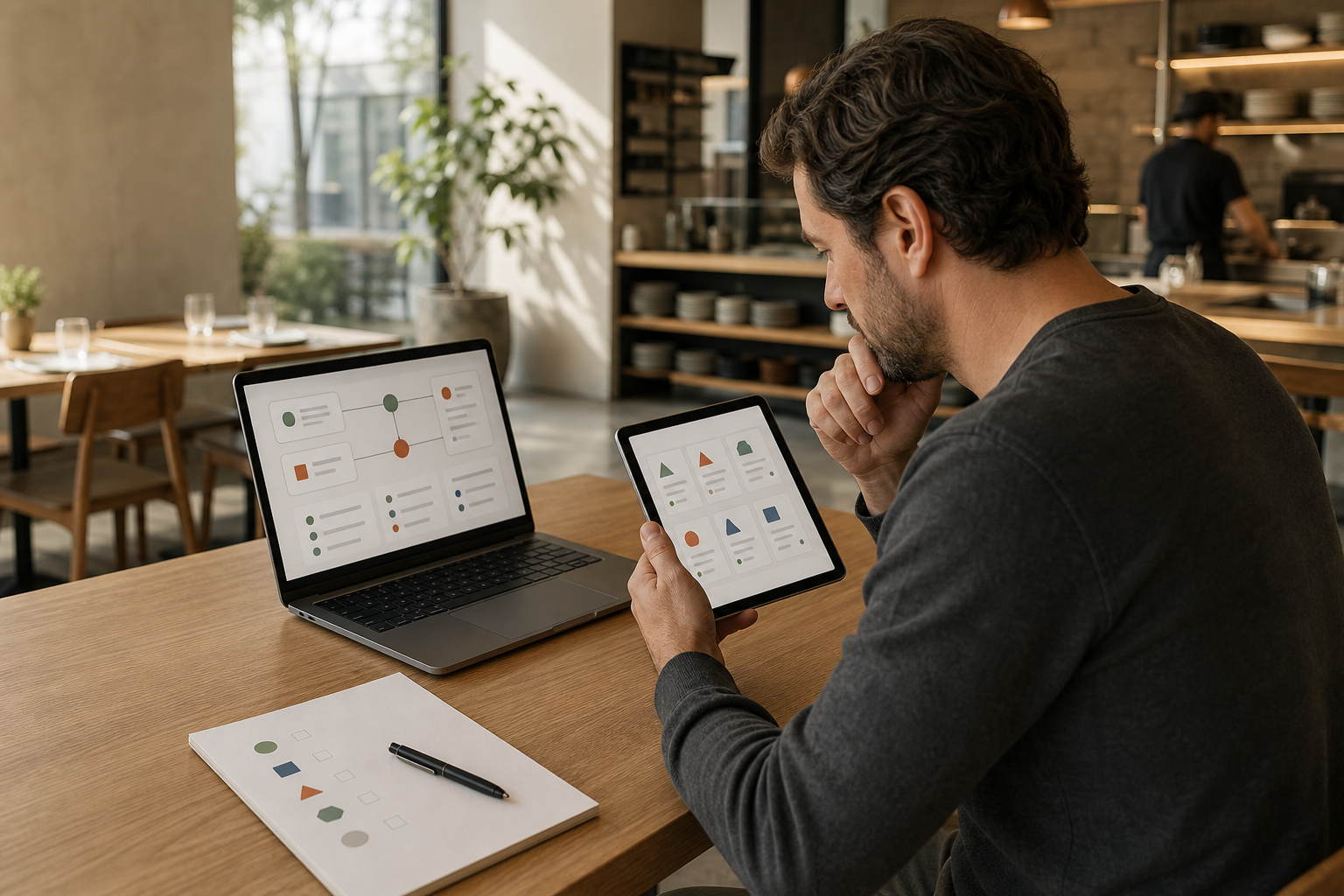
Direct online ordering is moving closer to the point of sale, making ownership of catalog data, prices, availability, handoff modes, hours, delivery settings, and failure handling more important. The operating question is not whether every restaurant should remove middleware; it is what each layer in the ordering stack actually does and who owns it when the order path breaks.
The National Restaurant Association's June 30 summer report adds the customer-side reason to care: in a survey of more than 1,000 consumers, the association identified increasing use of digital channels to discover restaurants.
When discovery begins on a website and the order must reach the correct location, kitchen, payment flow, and loyalty record, "integrated" is not a sufficient launch requirement. Restaurant operators need a testable picture of data ownership, supported workflows, failure behavior, and recovery. These eight questions help turn an integration promise into an operating plan.
For a broader systems view, review the ServingIntel integrated operations platform.
1. What problem is each layer solving?
Begin with the current path from the restaurant website to the ordering interface, POS, kitchen, payment processor, delivery provider, loyalty program, and reporting tools. For every system, write down the job it performs and the failure it prevents.
A middleware layer may translate menus, normalize modifiers, route orders, connect delivery providers, or provide reporting that the POS does not. A direct connection may reduce duplicate data and operational overhead, but only if the removed layer's useful work is replaced or no longer needed.
Do not evaluate the architecture by counting vendors alone. Evaluate the number of systems of record, manual handoffs, failure points, and support boundaries. A shorter diagram is helpful only when the real workflow is also simpler.
For neutral background and operating context, see National Restaurant Association dining research.
2. Which system owns each customer-facing fact?
Identify the source of truth for the restaurant name, location, hours, menu item, description, image, price, modifier, availability, tax treatment, service mode, delivery zone, and promised time. Then record which systems receive each field and how quickly an update should appear.
The July 7 announcement describes Square as the operating source for core menu and ordering data in that specific integration. Other combinations may split ownership differently. The website could own editorial descriptions and location content while the POS owns sellable items and availability. That can work, but the boundary must be explicit.
Test the awkward cases, not only a standard entree. Include nested modifiers, time-limited items, location overrides, sold-out products, catering quantities, alcohol restrictions, and special service hours. Those cases reveal whether "one source of truth" is real or only true for the simplest fields.
Related infrastructure planning is available in ServingIntel POS hardware guidance.
3. Which ordering workflows are actually supported?
Ask for a written matrix covering pickup, delivery, dine-in, scheduled orders, ASAP orders, curbside, catering, tips, taxes, fees, discounts, gift cards, loyalty rewards, refunds, voids, and partial item availability. Mark what is supported at launch, what requires configuration, and what is excluded.
An API can accept an order without reproducing every workflow an operator expects. Confirm where staff see the order, how it is labeled, when it fires to the kitchen, whether promise times are returned to the guest, and how changes after submission are handled.
If a provider uses phrases such as "real-time" or "native," translate them into measurable behavior. Define the expected synchronization time, retry interval, status path, and alert threshold. The goal is not to challenge marketing language; it is to turn it into a shared test plan.
4. How are location and fulfillment decisions preserved?
The website must send the guest into the correct store and service mode. Verify how a selected location is represented, whether the selection survives account sign-in and page refreshes, and what happens when the chosen store is closed or cannot support the requested fulfillment method.
A complementary portfolio perspective is available in the 86 The POS payment questions.
For delivery, confirm who owns the address check, zone rules, fees, dispatch request, courier status, and customer support handoff. For pickup, confirm promise-time logic, throttling, prep instructions, and where the guest is told to wait.
Multi-location tests should include at least one standard store and every configuration variant. A successful order at the default location does not prove that location-specific menus, taxes, hours, and routing are correct elsewhere.
5. Who owns checkout identity, consent, and loyalty?
Direct ordering often aims to strengthen the restaurant's customer relationship, but ownership is more than collecting an email address. Document which company is the merchant of record, which system stores the guest profile, what consent language appears, where loyalty enrollment happens, and how a customer can correct or delete information.
Use the following resource when assigning escalation and recovery ownership: ServingIntel support resources.
Check whether a guest can order without an account, how returning users are recognized, and what happens when the website, ordering provider, and POS have different records for the same person. Confirm whether loyalty balances and eligible rewards are visible before payment and whether an enrollment failure can block checkout.
Treat vendor claims about customer value as promotional until they are supported by the restaurant's own reporting. For launch, the practical questions are whether identity is handled consistently, consent is clear, and staff know which team owns a customer-data issue.
6. What happens when the connection fails?
Map failures for catalog synchronization, item availability, payment authorization, order creation, kitchen routing, delivery dispatch, loyalty posting, confirmation messaging, and status updates. For each failure, define what the guest sees, what staff see, who is alerted, and whether retrying could create a duplicate.
For additional independent reference material, review Federal Trade Commission business guidance.
The website should not show a successful confirmation until the agreed source has accepted the order. If the ordering interface loses contact with the POS, decide whether ordering pauses, falls back to another path, or continues with a visible limitation.
Run controlled tests for timeouts, duplicate submissions, closed stores, invalid modifiers, and items that become unavailable during checkout. Record the order identifier across systems so support teams can trace one transaction without guessing.
7. How will the public website stay accurate?
The restaurant website remains a discovery and verification surface even when checkout is powered elsewhere. The Orders.co July 17 article is vendor-authored, but its focus on mobile usability, direct ordering, readable menus, and clear calls to action reflects a practical website checklist. The National Restaurant Association's June 30 report separately supports the importance of digital discovery.
Keep hours, location details, service options, menu paths, and order calls to action useful before the checkout handoff. If sellable menu data comes from the POS, clarify which content updates automatically and which pages still require editorial maintenance.
For another practical workflow in the portfolio, read the POS Digital Display endpoint review.
Test the public journey on a real phone from search result to location selection, menu, checkout, confirmation, and recovery. Include old bookmarks and campaign landing pages. A new integration does not repair stale website pages by itself.
8. Who can launch, stop, and roll back the connection?
Assign named owners for website changes, POS configuration, ordering setup, payments, loyalty, delivery, analytics, and customer support. Record the escalation route for each provider and the hours when launch support is available.
Before go-live, preserve the prior website route, order destination, configuration values, and test evidence. Define the conditions that stop the launch or trigger rollback: missing items, price mismatch, wrong-location routing, duplicate orders, absent kitchen tickets, payment reconciliation errors, or an unavailable recovery path.
For additional restaurant and senior-living technology context, consult ServingIntel News & Insights.
Teams mapping a broader restaurant technology stack can use ServingIntel's overview of restaurant and senior living software to frame system responsibilities. Establish a cross-system escalation path with the ServingIntel support team before a time-sensitive rollout.
The recent direct-to-POS announcement shows that restaurants have more architecture choices. The useful decision is not automatically "direct" or "middleware." It is the option whose data ownership, workflow coverage, failure behavior, and support boundaries can be explained and tested from the first website click to the final kitchen ticket.